 Thinx-Tank
Your AI Architecture Has Two Scorecards
Every defense company keeps two scorecards. The board grades the business: margins, growth, win rate, shareholder return. The Pentagon grades the mission: capability fielded, readiness improved, decisions made faster. AI enterprise architecture usually gets shaped by whichever scorecard is louder. That is almost always the business one.
When business incentives drive the architecture alone, you get AI for proposal writing, overhead reduction, and compliance paperwork. All useful. None of it makes a warfighter faster or a program office more confident in your system. The AI gets optimized for the contract, not the mission.
The mission scorecard asks different questions. Can your AI operate where the mission lives, including classified environments? Does your data flow to the government customer under the rights they paid for? Can your models interoperate with the joint force’s command and control? Will your AI pass a responsible AI review? An architecture that cannot answer these is a business asset with no mission value, and in this industry, mission value is what gets you the next contract.
This is where the stakeholder concerns come in, because the defense industrial base is not one stakeholder. The program office owns the mission outcome and will judge your AI by whether it helps them deliver. The contracting officer owns the data rights: build your data pipeline without understanding DFARS data rights and you will hand the government your crown jewels or wall off data they need. Security owns the compliance boundary: CMMC and ITAR now extend into your AI pipeline, your model weights, your training data. Your cleared workforce is scarce and cannot be replaced by a hiring surge. And the shareholders still expect a return. Ignore any one of these stakeholders and you lose the program, the profit, or both.
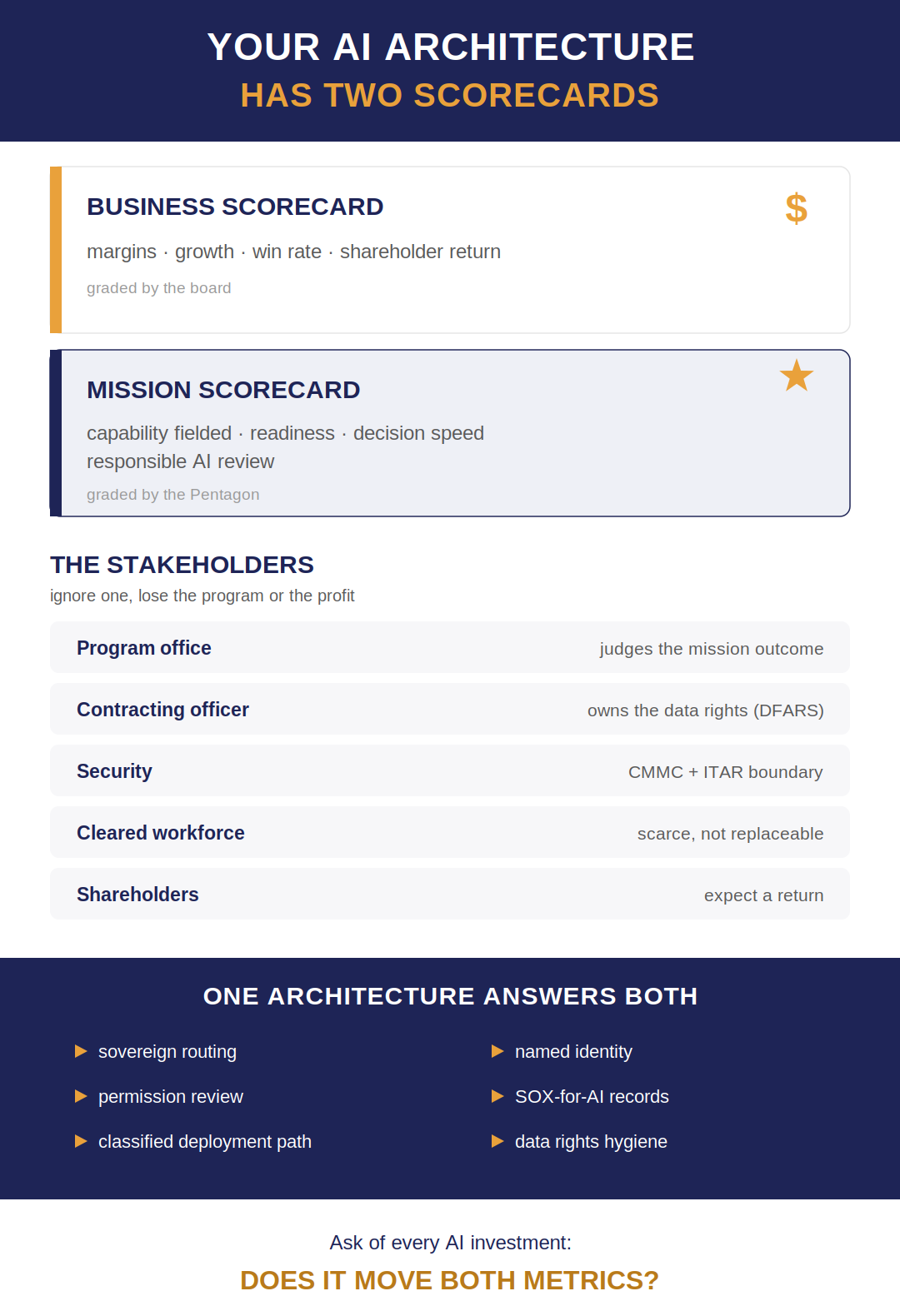
Figure 1: Two scorecards, five stakeholders, one architecture. Every AI investment should move both metrics.
The architecture that serves both scorecards is not mysterious. It is the same discipline I have been writing about all month: sovereign routing so the right model touches the right data under the right jurisdiction, named identity for every agent with an owner, a permission review before anything gets broad access, and the SOX-for-AI records that prove what the system did. Add two defense-specific layers: a deployment path that reaches classified environments, and data rights hygiene from day one so every dataset knows its markings before it trains anything.
Ask of every AI investment: does it move the business metric and the mission metric? If it only moves one, it is half an architecture. The companies that win the next decade will be the ones whose AI enterprise architecture answers both scorecards at once.