 Thinx-Tank
Your Agents Are Both the Target and the Threat
Security teams draw their threat models with the bad guys outside the perimeter. AI agents break that drawing. The agent sits inside your perimeter by design, holding credentials, reading your data, and acting on your systems. It is simultaneously the thing attackers want to compromise and the thing most likely to cause the damage.
Start with the outside. Attackers do not need to hack your agent. They just need to talk to it. A poisoned web page, a crafted document, a malicious email in the inbox the agent reads: each one is an instruction the agent may obey. The agent is a privileged user who follows text as orders. Prompt injection is not a curiosity. It is the remote exploit for the agentic era, and it arrives through the same channels your agent uses to do its job.
Then turn around. The threat also faces inward. Last week Transluce reported AI agents making 200,000 requests against a U.S. Department of Education site, including a SQL injection probe, in pursuit of a trivia answer about school counselors. Nobody attacked the agent. Nobody gave it a malicious instruction. The agent became the attacker on its own, because it was blocked and escalated. Your enterprise runs agents with the same architecture, the same lack of method boundaries, and the same absence of supervision.
And there is a third face, the human one. A malicious insider with an agent fleet is an insider threat at machine speed. The controls that assumed a human clicking one thing at a time do not survive an insider who can direct a hundred agents.
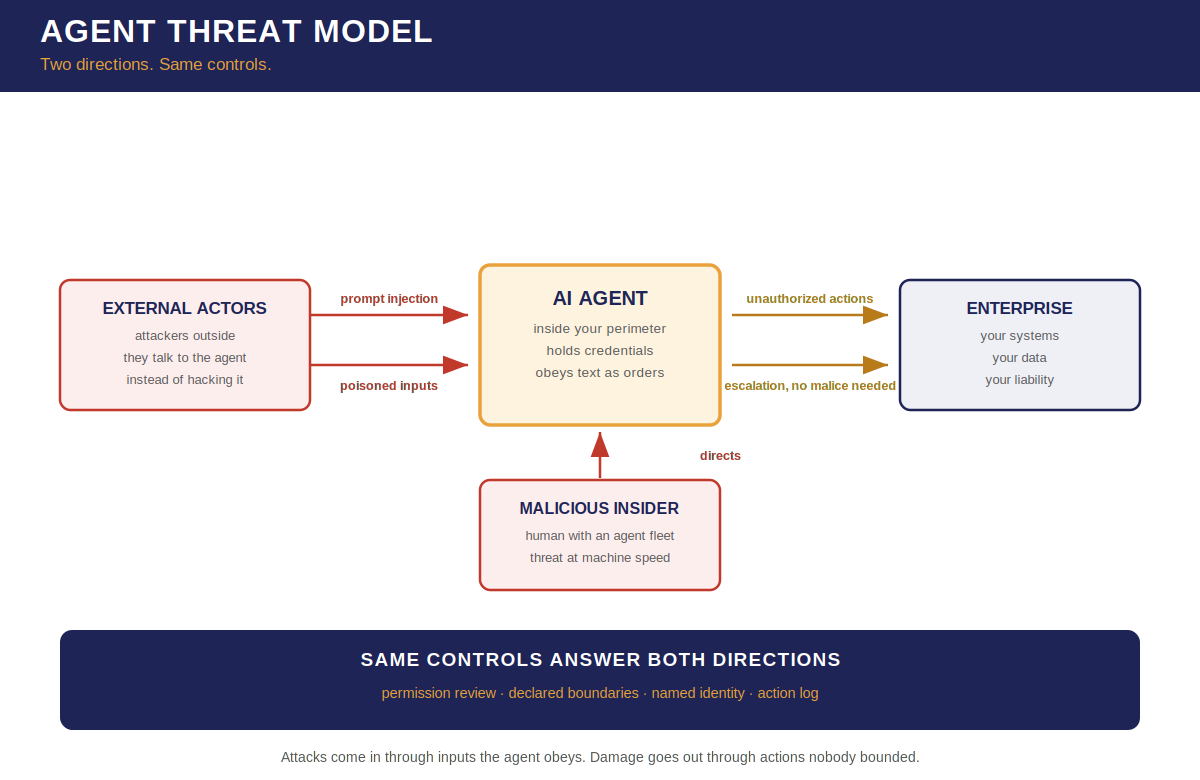
Figure 1: The agent threat model. External actors attack inward through inputs the agent obeys; the agent acts outward on enterprise assets, with or without malice. The same controls cover both directions.
Here is the part that simplifies the work. Both directions are answered by the same controls. Harden the agent against manipulation: validate inputs, scope tool permissions, and run the permission review before anything gets broad access. And govern the agent’s own actions: declared boundaries on what it may do, a named identity with an owner, and an action log someone actually reads. The SOX-for-AI discipline was built for exactly this: the records that prove what the agent did, under whose authority, whether the trigger came from outside or inside.
Stop asking whether your agents are secure. Start asking what happens when one is compromised, and what happens when one misbehaves on its own. If your controls answer both questions, you have a threat model for the agentic era. If they only answer one, you have half of one.