 Thinx-Tank
What I Mean When I Say AGI
AGI can mean pretty much anything the marketing department decides it means. That is not a joke. It is the documented history of the term.
Since 2020, the AGI-optimist program has executed at least four major definitional shifts. First AGI meant human-level intelligence across all cognitive domains. When systems could not pass serious Turing tests, the bar moved to capability levels. When capability levels proved gameable, the definition contracted to behavioral thresholds. Now we get “doing a significant amount of the work in the world” and “the ability to figure things out.”
Each redefinition is narrower than the last. Each accommodates what current systems already do, or almost do. None of them generates a novel prediction that would distinguish genuine general intelligence from sophisticated pattern matching. When the people who need AGI to be imminent are the ones defining it, the fix is in.
So let me fix my own definition, in public, where it cannot retreat.
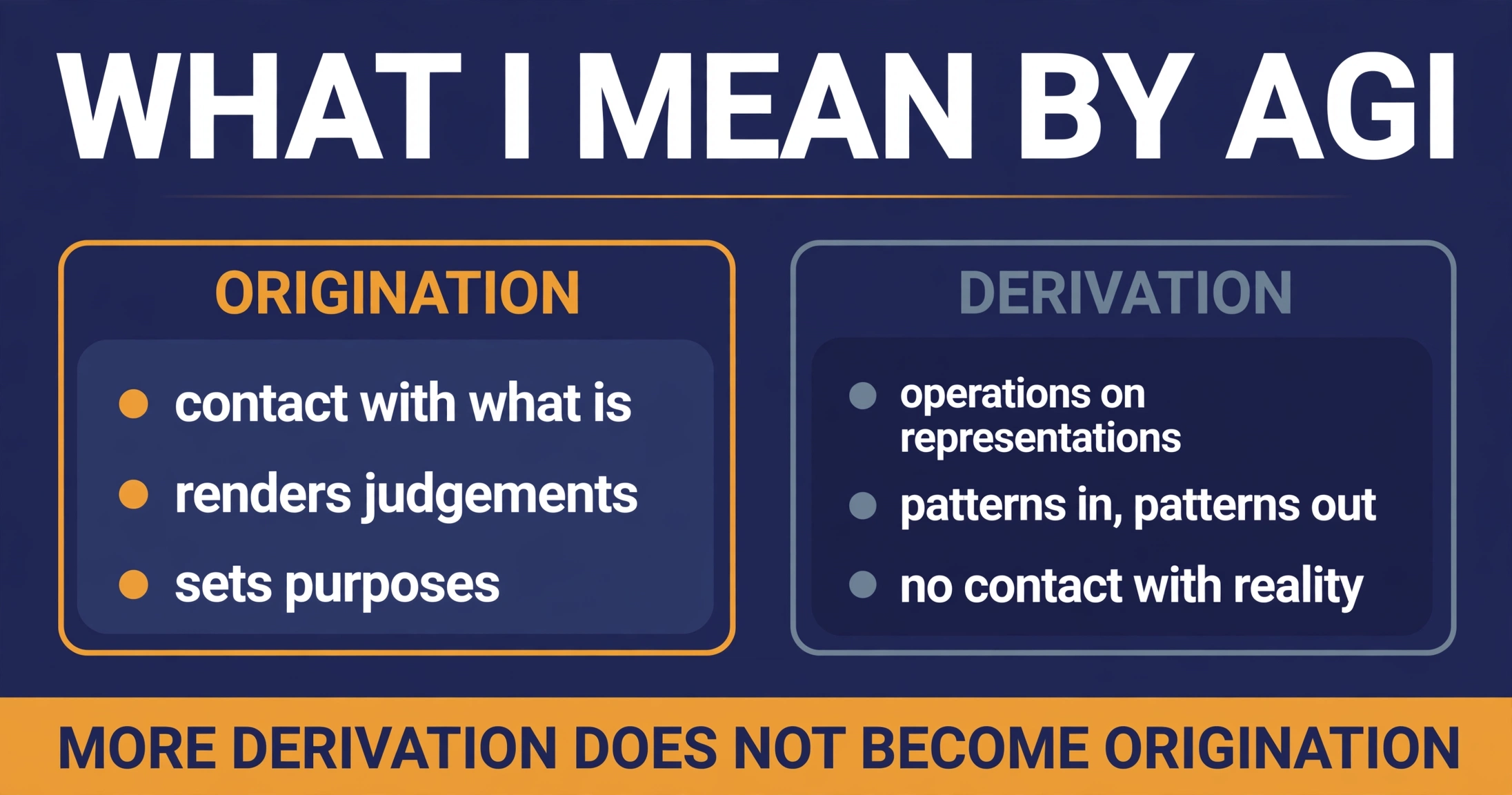
AGI would be a system capable of origination.
I use two terms precisely. Derivation is the transformation of inputs according to learned patterns: operations on representations producing representations. Every current AI system, without exception, derives. Origination is the capacity to access reality, render judgments, set purposes, evaluate truth. Contact with what is.
These differ in kind, not degree. More derivation does not become origination. More parameters, more data, more inference compute: all of it extends derivation. None of it produces origination.
Qualia belongs in this definition, not as decoration but as load-bearing structure. Origination requires contact with what is, and subjective experience is the most direct form of that contact. A system that only transforms representations can model the report of an experience. There is nothing it is like to be the model. Derivation can simulate the outputs of a mind. It cannot have the inside of one.
Human cognition originates. We access novel configurations through causal contact with reality, through embodied experience, through the capacity to know that we know. A model trained on the products of that cognition has access to the products, not the contact. It processes the finite artifacts of our infinite access. That is not a limitation to be engineered away. It is the architecture.
This is why the definitional retreat keeps happening, and why it will keep happening. If the gap between derivation and origination is categorical, then every attempt to define AGI in terms achievable by derivation-only systems must narrow the definition. Watch for it. It is the most reliable tell in the industry.
None of this is an argument against building with current systems. They are remarkable derivative tools. It is an argument against waiting. Enterprise leaders should stop planning around the arrival of AGI and start deploying AI inside its epistemic boundaries: clear about what the system is for, and clear about who supplies the judgment it structurally lacks. The failure rates in enterprise AI are not a model quality problem. They are a category error, made at the planning stage.
Definitions are commitments. Mine is fixed: general intelligence means origination, origination requires contact with what is, and no scaling curve crosses a categorical gap. Hold the industry to the same standard. Watch the definitions, not the demos.