 Thinx-Tank
How Companies Integrate Their Values into the Broader AI Ecosystem
Most of the AI ecosystem is general-purpose on purpose. Foundation models, agent frameworks, MCP servers, tool catalogs, and most vendor control planes are built to be reused by anyone. They optimize for capability, interoperability, and scale. What they do not carry, by default, is any particular company’s values: its risk posture, its approval culture, its attribution rules, its authority model.
Deploy agents into that ecosystem without binding those things in, and the agents inherit defaults: the model’s, the framework’s, the platform’s, or whatever the prompt of the moment happens to say. Those defaults are rarely the organization’s own. The fix is a governance layer under the agents: a meta-harness with constitutional surfaces an agent cannot rewrite, and a kernel that decides what actually takes effect.
The integration problem
Agent frameworks (LangGraph, AutoGen, CrewAI, Claude Code, Codex, and others) provide reasoning loops and tool use. Gateways and agent fabrics provide traffic control, identity propagation, rate limiting, PII filters, cost caps, and kill switches. All of that is necessary. None of it is sufficient for organizational values, because values show up as a different kind of question:
- What must always require human acceptance?
- How is attribution recorded, including the rule that the work is Human-Curated, AI-Enabled (HCAE)?
- Which memory counts as authoritative, and which is merely retrieved?
- What prohibitions and permissions define acceptable action for a given role?
- Who is the terminal authority when the agent and the human disagree?
None of those are model questions. They are organizational questions, and they need a contract that travels with the agents and holds no matter which vendor or model sits underneath.
Where the values live
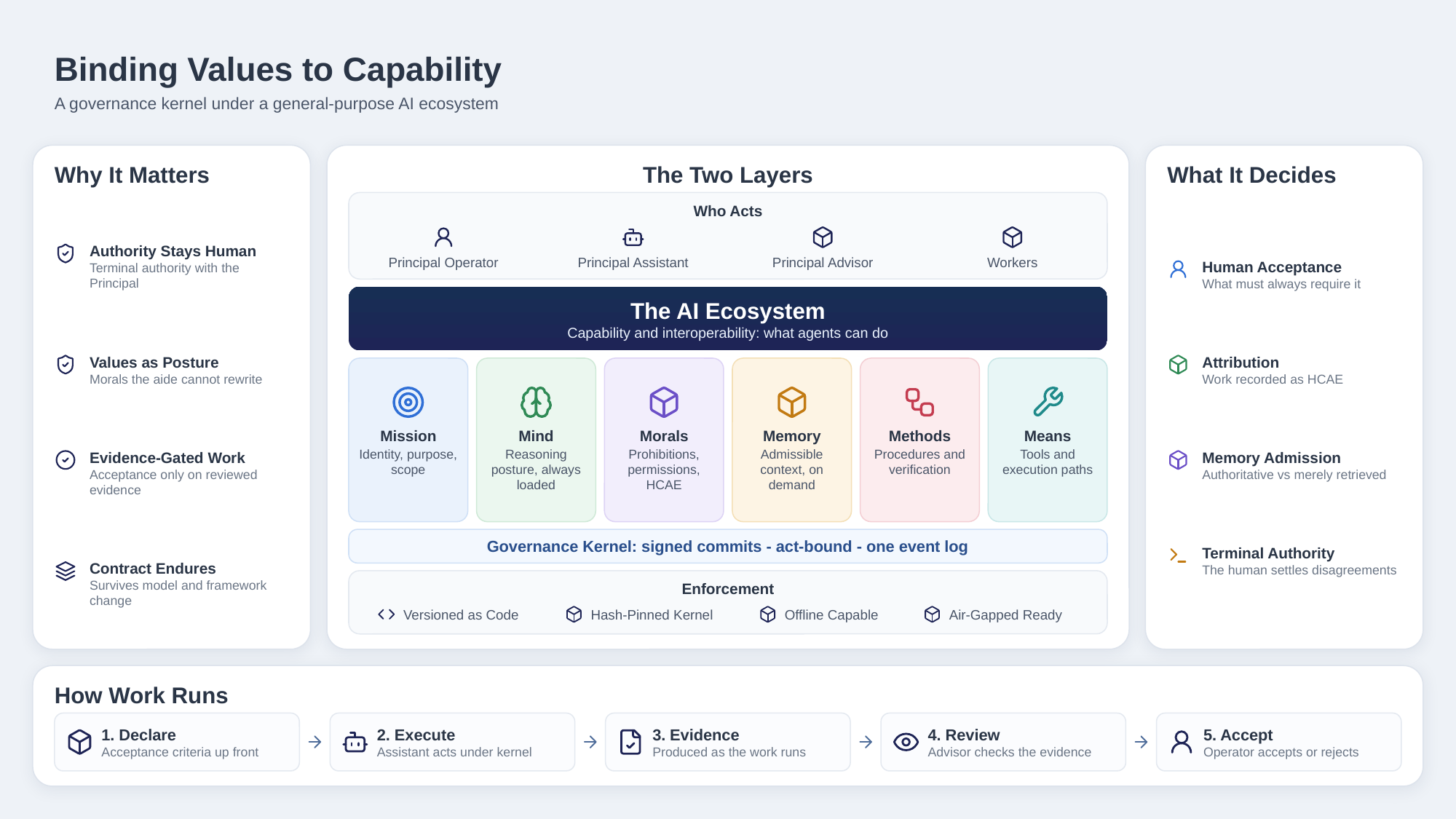
In The MxM Fabric Defined I laid out the fabric I build and run under. Its design premise is that the aide holds no authority of its own. Authority flows from a human Principal Operator. A Principal Assistant acts. A Principal Advisor reviews the evidence before the human accepts the work. Six surfaces form the constitutional contract: Mission, Mind, and Morals are loaded for every run and immutable mid-run; Memory, Methods, and Means are pointer-shaped, pulled in on demand as the work requires.
The Morals surface is the most direct carrier of an organization’s values: its prohibitions, its permissions, and its attribution rules. Because Morals is posture rather than a prompt, the aide cannot rewrite it to suit the task in front of it. Side effects exist only if the kernel commits them, and those commits are signed, act-bound, and recorded in a single event log that produces chained evidence.
Work is packaged the same way. Acceptance criteria are declared up front. Evidence is produced as the work runs. The Advisor reviews it, and the Operator accepts or does not. The audit trail then shows not only what happened but that it happened under the organization’s stated constraints. It is Everything as Code applied to governance: the constitution, the work packages, the kernel releases, and the evidence are all versioned and reviewable, and the kernel can be vendored and hash-pinned so the same contract runs offline or in an air-gapped environment.
What the other layers do
None of this replaces the ecosystem’s own governance tools, and it helps to be clear about what each one is for. MuleSoft’s Agent Fabric is a control plane for multi-vendor estates: an Agent Registry that finds agents across platforms, an Omni Gateway enforcing policy inline at the MCP boundary (PII detection, access control, audit logging), Trusted Agent Identity propagating user context across hops, cost controls, and an agent kill switch. It is the right tool for discovering agents across an estate and applying consistent operational controls at scale.
Databricks’ Omnigent works a different seam. It is an open-source meta-harness that sits above existing coding agents, Claude Code, Codex, and others, so teams can compose and swap harnesses and apply stateful policies (allow, ask, or deny) without rewriting the agents. It is strong on composition and multi-agent orchestration. Research efforts that tune harnesses for accuracy, safety, or token efficiency are complementary in the same way: they improve the harness. They do not define an organization’s authority.
An MxM-style layer occupies a different niche. It is less a productized control tower and more an operating agreement: an explicit human and AI triad, constitutional surfaces the aide cannot rewrite, a kernel stance that the agent has zero inherent authority, offline-capable enforcement, and acceptance gated on evidence. It does not replace gateways or frameworks. It binds them to one organization’s authority and values.
The practical pattern
So the pattern I would run separates the concerns. Take capability and interoperability from the ecosystem: models, frameworks, MCP servers, tools, and, where they earn their place, vendor gateways and control planes. Put authority in the meta-harness: the organization’s authority model, its values, its memory admission rules, and its evidence requirements. The first layer supplies what the agents can do. The second layer decides what they are allowed to do under this organization’s rules, and produces the record that shows the rules were followed.
Because the constitutional surfaces and the kernel are versioned, and in a design like MxM can run offline, the organization’s values travel with the harness. They do not live only in a cloud policy service or in a system prompt someone wrote once. When the models and frameworks underneath change, and they will, the contract does not have to be rewritten from scratch.
A company does not integrate its values into the AI ecosystem by choosing a better model or a more capable framework. It does it by placing an enforceable organizational contract underneath them: Mind, Morals, and Mission stated as posture, authority kept with the human Principal, and side effects that exist only when the kernel commits them under that contract. Vendor fabrics and composition layers earn their keep on scale and orchestration. The governance kernel is what makes those capabilities operate under a particular organization’s values instead of the ecosystem’s defaults.