 Thinx-Tank
The MxM Fabric Defined
In Personal Agents, Workers, and the Fabric That Governs Them, published earlier today, I made the argument: a personal agent faces the human, workers do the delegated work, and what governs both cannot live in a model’s disposition. It has to live in a fabric, where behavior is written down, versioned, and checkable. This post defines that fabric.
MxM is a multi-mode meta-harness. It defines, enforces, and proves how agents behave, what they can do, and how they are held accountable, across models, vendors, runtimes, and organizations. The short version fits in four phrases: define once, bootstrap everywhere, govern at scale, endure through change. Everything below is those four phrases made concrete.
Where the fabric sits
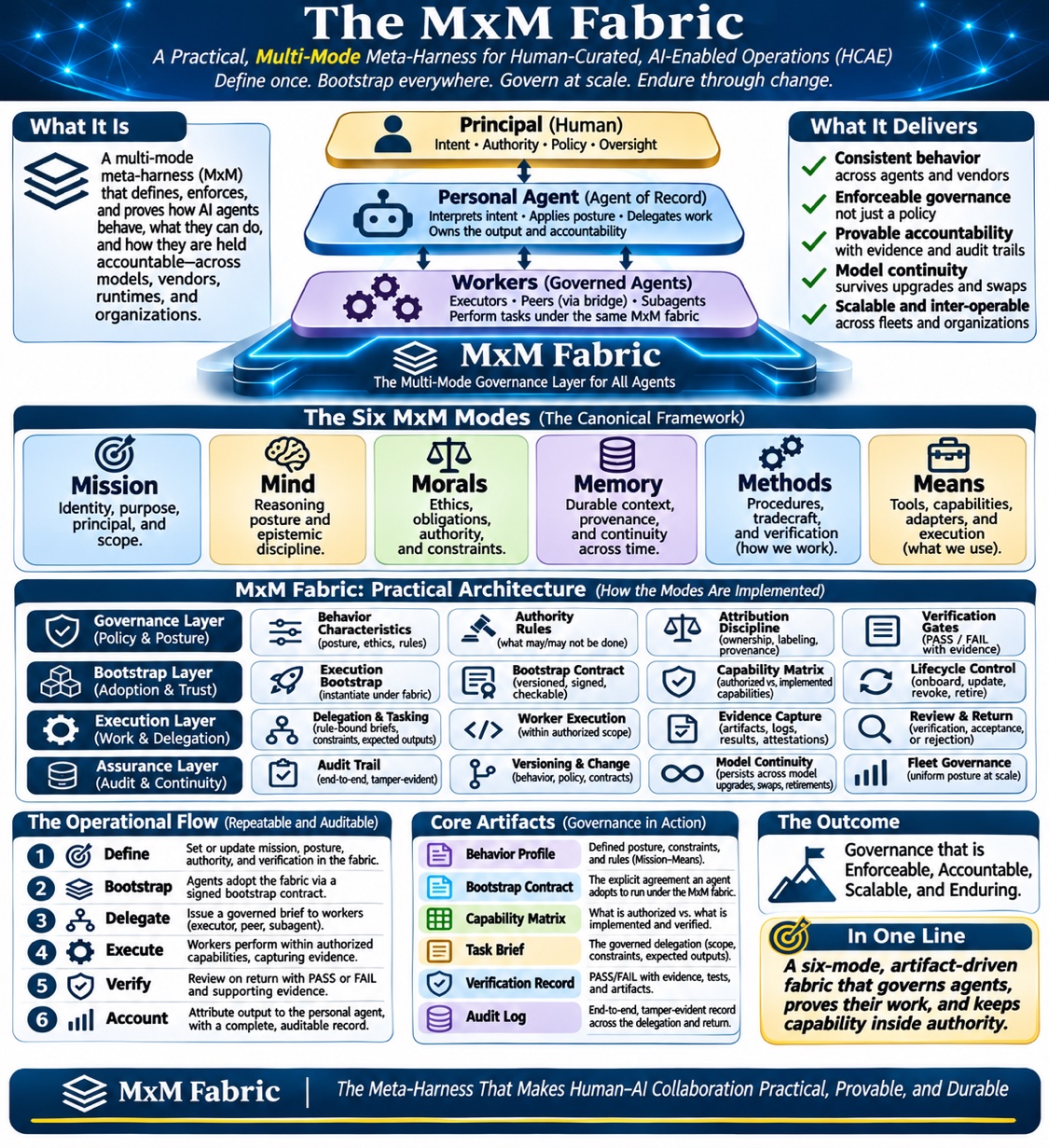
The stack has three tiers. At the top is the Principal, the human, who holds intent, authority, policy, and oversight. Below the Principal is the Personal Agent, the agent of record: it interprets intent, applies a defined posture, delegates work, and owns the output and the accountability for it. Below that are the Workers, the governed agents: executors in their own lanes, peers reached through a bridge, subagents spawned for a single task. Every tier runs under the same fabric. That sameness is the point. A worker does not inherit governance secondhand from the agent that dispatched it; it bootstraps under the fabric in its own right.
The six modes
MxM behavior is defined in six modes. Together they answer the questions a governed agent has to settle before it acts.
Mission. Identity, purpose, principal, and scope. Whose agent this is, what it is for, and where its remit ends.
Mind. Reasoning posture and epistemic discipline. How the agent thinks, what it treats as evidence, and how it handles what it does not know.
Morals. Ethics, obligations, authority, and constraints. What the agent may and may not do, and whose word settles a conflict.
Memory. Durable context, provenance, and continuity across time. What the agent remembers, where it came from, and what it may carry forward.
Methods. Procedures, tradecraft, and verification. How the work is done, and how it is checked.
Means. Tools, capabilities, adapters, and execution. What the agent can actually touch, and through which governed paths.
How the modes are implemented
Modes on paper govern nothing. MxM implements them in four layers.
Governance layer (policy and posture). Behavior characteristics, authority rules, attribution discipline, and verification gates are defined here, once, as artifacts of the fabric.
Bootstrap layer (adoption and trust). An agent comes under the fabric by an explicit bootstrap: an execution bootstrap that instantiates it under the fabric, a bootstrap contract that is versioned and checkable, a capability matrix that states what is authorized against what is implemented and verified, and lifecycle control for onboarding, update, revocation, and retirement.
Execution layer (work and delegation). Delegation and tasking run on rule-bound briefs with constraints and expected outputs. Workers execute inside their authorized scope, evidence is captured as they go, and review on the return path verifies, accepts, or rejects the result.
Assurance layer (audit and continuity). An end-to-end audit trail, versioning and change control over behavior, policy, and contracts, model continuity across upgrades, swaps, and retirements, and fleet governance that keeps posture uniform at scale.
The operational flow
Day to day, the fabric runs a six-step loop. Define: set or update mission, posture, authority, and verification in the fabric. Bootstrap: agents adopt the fabric under a signed bootstrap contract. Delegate: issue a governed brief to workers. Execute: workers perform within authorized capabilities, capturing evidence. Verify: review on return, with PASS or FAIL and supporting evidence. Account: attribute output to the personal agent, with a complete and auditable record. The loop is repeatable, and every step leaves an artifact.
Core artifacts
That is the test of whether governance is real: it produces artifacts. The behavior profile, an agent’s defined posture and rules. The bootstrap contract, the explicit agreement the agent runs under. The capability matrix, what is authorized against what is implemented and verified. The task brief, the governed delegation itself, with scope, constraints, and expected outputs. The verification record, PASS or FAIL with evidence, tests, and artifacts. The audit log, end to end and tamper-evident, persisting across the delegation and the return. If a claimed control has no artifact, it is a hope, not a control.
The outcome is governance that is enforceable, accountable, scalable, and enduring: consistent behavior across agents and vendors, accountability you can prove with evidence and audit trails, and continuity that survives model changes because the governance was never in the model. In one line: a six-mode, artifact-driven fabric that governs agents, proves their work, and keeps capability inside authority.