Thinx-Tank
Sovereignty Is a Routing Problem
Every enterprise AI conversation hits the same wall: the data cannot leave, but the best models live outside. The two usual answers are both wrong. Banning frontier models leaves capability on the table. Allowing them by default builds an IP pipeline into someone else’s training run.
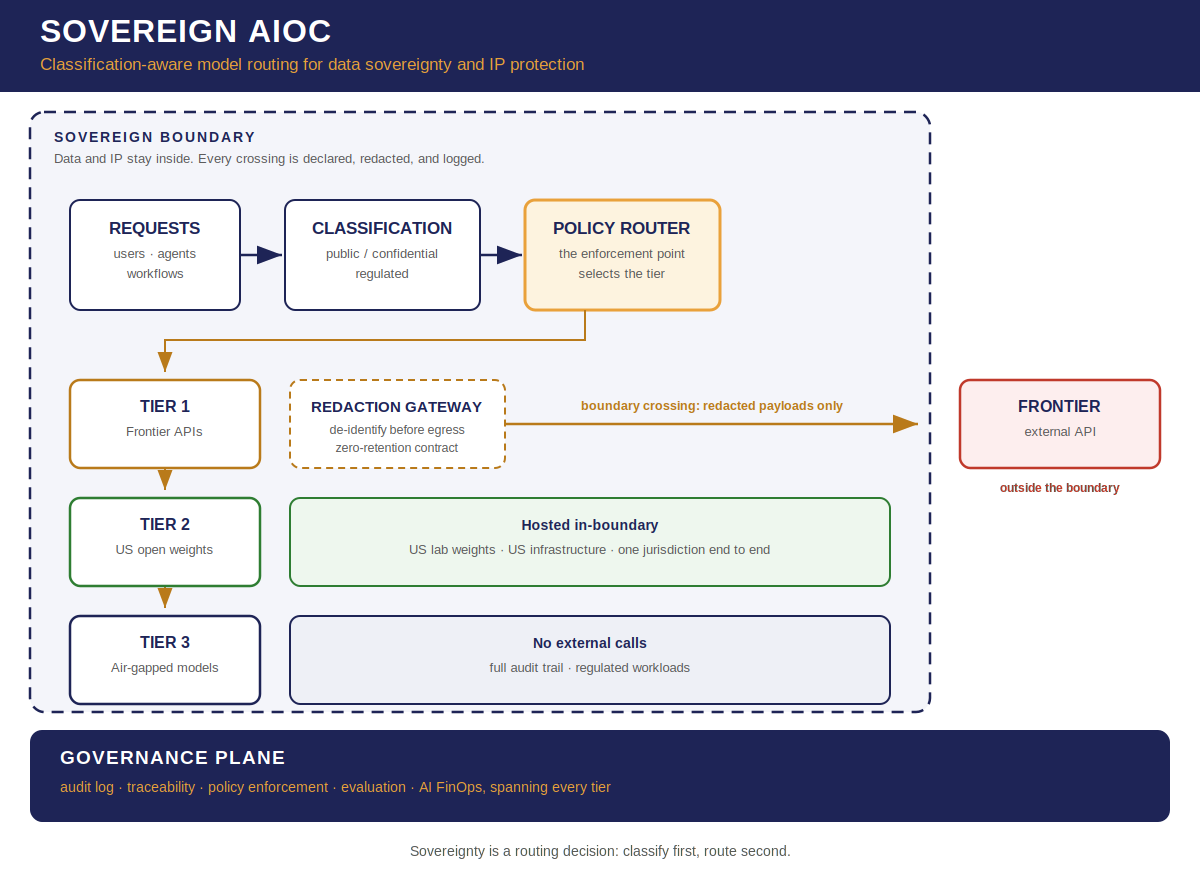
Data sovereignty is not a place. It is a routing decision. Every request gets classified, and the classification picks the model. The router is the policy enforcement point.
Three tiers. Public and low-sensitivity work can go to frontier APIs, under zero-retention contracts. Confidential work stays inside the boundary on US open-weight models. Nothing crosses. Regulated work runs on air-gapped open weights with no external calls and a full audit trail.
The real engineering is in the boundary crossings. Every frontier call is data leaving your control, so the AIOC redacts or de-identifies before egress. Get that wrong and the middle tier leaks quietly for months.
The US-based qualifier does real work. Open weights you can inspect and host, but vendor jurisdiction travels with the model. A French or Chinese lab’s license terms and legal exposure come with the weights. US lab, US infrastructure, US law: one jurisdiction end to end.
This is the declared-boundaries discipline applied to data flow. Yesterday’s FinOps piece used the same router to optimize cost. Same mechanism, different objective function: cost there, jurisdiction here.
Step back and the shape is familiar. This is ERP for AI: the model registry is inventory, the policy router is procurement approvals, FinOps is financials, and the audit trail is compliance. The system of record for AI, the way ERP is the system of record for everything else.
The viewpoint below lays out the architecture: classification, the policy router, the three tiers, and the redaction gateway guarding every crossing.