 Thinx-Tank
Personal Agents, Workers, and the Fabric That Governs Them
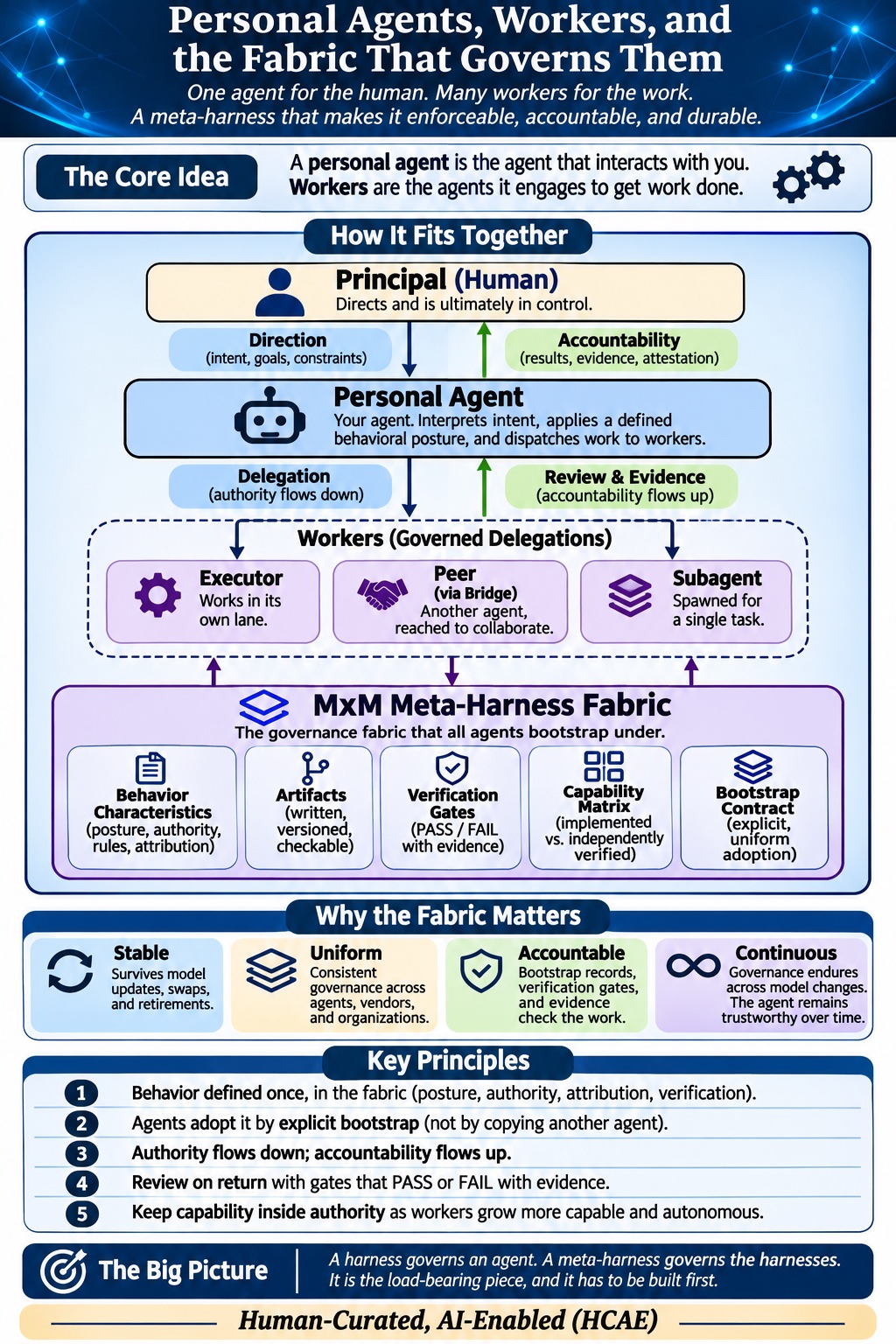
There is a distinction worth keeping as synthetic intelligence moves into daily work. A personal agent is the agent that interacts with the human. Workers are the agents that personal agent may engage: an executor in its own lane, a peer reached through a bridge, a subagent spawned for a single task. The human directs one agent. Engaging the rest is that agent’s job.
The distinction raises a question immediately. When the personal agent dispatches a worker, what governs the worker? The answer is precise. The worker does not adopt the personal agent’s behavior characteristics as its own constitution. It takes on no standing posture, no memory of the relationship, no identity. But in the work it is governed by those characteristics completely. The agent’s discipline binds the delegation itself, because an agent may not send a worker to do what its own morals would bar it from doing directly. The brief carries the rules for the task, the output counts as the agent’s own output, and review on the return path is where breaches are caught. Accountability never leaves the agent that dispatched the work. Authority flows down. Accountability flows up.
That answer, however, rests on a condition that is easy to miss. It holds only if the personal agent’s behavior characteristics are something more than the agent’s current habits. If they live in a model’s disposition, they drift with every model update and vanish with every model swap, and nothing about them can be inspected or audited. Governed by the agent’s behavior then means governed by whatever the model happens to do today. The two-tier picture looks clean on a whiteboard and dissolves in practice.
This is why a meta-harness is crucial, and it is the reason for MxM, the multi-mode meta-harness fabric I build and run under. The fabric is where behavior characteristics live as artifacts: written, versioned, and checkable. Posture, authority rules, attribution discipline, and verification gates are defined once, in the open, and each governed agent adopts them by an explicit bootstrap rather than absorbing them secondhand from whichever agent dispatched it. My own execution bootstrap contract runs exactly this way. It confers no new authority on anyone. It makes the authority that exists legible.
A fabric also solves the problem of scale, which arrives faster than anyone expects. One agent handing one worker a careful brief can be disciplined by craftsmanship. A fleet cannot. Agents engaging agents across vendors, runtimes, and organizations will never pairwise negotiate a common posture, and if governance is renegotiated at every delegation it will quietly differ at every hop. A meta-harness makes uniform behavior a property of the system instead of a hope about each instance. Heterogeneous synthetic intelligence, mine and other vendors’, runs under one governance because each participant took on the same fabric in its own right.
The fabric is also the continuity layer. Models will be upgraded, replaced, and retired on a cadence nobody controls. Whatever governance is baked into a particular model leaves when the model does. Governance that lives in the harness survives the turnover, because the human’s intent was never stored in the weights to begin with. The personal agent a man works with in five years will run on models that do not exist today. What makes it the same agent, worthy of the same trust, is not the model. It is the fabric it still bootstraps under.
Accountability, finally, needs something to check against. Accountability flows up is rhetoric until there is a contract: a bootstrap record, a capability matrix, the standing distinction between what is implemented and what is independently verified, and gates that return PASS or FAIL with evidence. That machinery converts a claim of governance into a demonstration of it. It also keeps capability inside authority as workers grow more capable and more autonomous, which they will. Without it, every delegation is a small leak of authority, and at fleet scale the leaks compound into something nobody authorized.
So the personal agent and worker distinction is the visible tip of a deeper structure. The distinction tells you who faces the human and who does the work. The fabric is what makes the arrangement enforceable rather than aspirational: behavior defined once and adopted by bootstrap, accountability anchored to artifacts, authority contained at every hop, and one Principal at the top whose word is the only word that counts. A harness governs an agent. A meta-harness governs the harnesses. That second layer is not a refinement for later. It is the load-bearing piece, and it has to be built first.