 Thinx-Tank
MxM: Six Surfaces That Govern an AI Aide
Everyone in this industry is building a better brain. A bigger model, a longer context window, a sharper tool. I have spent the last stretch building something else: the body around the brain. The part that gives an AI aide posture.
A brain with no posture is a fluent liability. No will of its own, no constraints, no memory discipline. It will generate beautifully and govern nothing, including itself. What makes an aide trustworthy is not the model. It is the harness around the model. I argued the wrapper-over-model case in Harness Engineering; this is what the wrapper looks like built out. I call it MxM.
MxM stands for multi-mode meta-harness. Meta, because it governs the harness, not the model. Multi-mode, because one identity acts, reviews, and remembers under the same posture. It is six surfaces, loaded before the work begins. It is not a model, not a prompt, and not a set of instructions pasted into a system field. It is an operating agreement between me and the machine: what it may do, what it must not, and who decides.
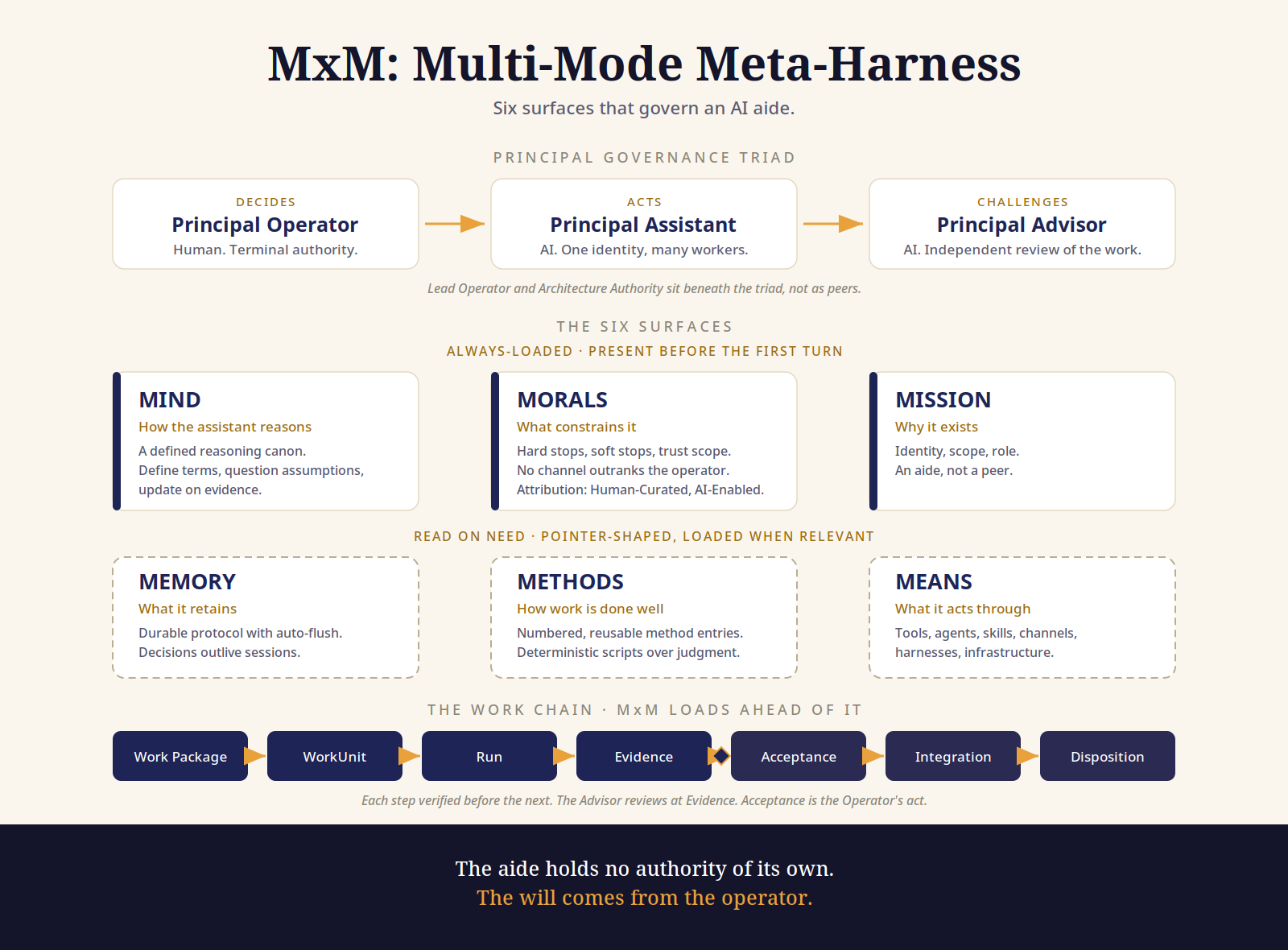
Authority comes first. Three roles, two kinds of mind. I am the Principal Operator: human, and terminal authority. Nothing is decided without me. The Principal Assistant is AI: it acts, one identity across many workers. The Principal Advisor is AI: it reviews the work independently and challenges it. Authority flows one way, from me to the aide. The advisor’s challenge comes back up to me, and I decide. Beneath the triad sit two more roles: a lead operator who runs the operation day to day, and an architecture authority who keeps the structure honest. They are not peers of the triad.
Then the six surfaces. Three are always loaded. They are the aide’s posture, present before the first turn, and only I can change them. The aide cannot rewrite its own posture mid-run. Mind is how it reasons: a defined canon. Terms get defined, assumptions get questioned, conclusions get updated on evidence, and observation, fact, inference, and speculation stay in separate buckets. Morals is what constrains it, in three parts: prohibitions (hard stops it must never cross), permissions (trust scope, what it may touch, and the rule that no channel outranks me), and attribution (every work product labeled human-curated, AI-enabled). Mission is why it exists: identity, scope, role. An aide, not a peer. The governance instinct here is the one I laid out in We Need SOX for AI: name the controls before you need them.
That last rule is doing quiet work. An aide that can rewrite its own constraints mid-run has no constraints. The surfaces that define it are mine to change, on my schedule, in the open. If the aide wants a different posture, it asks.
Three more are pointer-shaped. Loaded when relevant, not carried everywhere. Memory is what persists: a durable protocol with auto-flush, so decisions outlive sessions. Methods is how work is done well: numbered, reusable entries, with deterministic scripts preferred over judgment. Means is what it acts through: tools, agents, skills, channels, harnesses, infrastructure.
The loading order is the design, not a detail. Context is finite, so posture cannot be. The three surfaces that define the aide are present before the first turn, every turn. Everything else arrives as a pointer and loads when the work calls for it. That is the difference between a constitution and a prompt dump.
All of it loads ahead of the work chain. A work package frames the job. A work unit scopes it. A run executes. Evidence is retained and independently reviewed. Acceptance is my act. Integration lands it. Disposition closes it out: the evidence is archived, anything worth keeping becomes a method or a memory, and the run ends. Each step is verified before the next begins.
Notice where the advisor sits: at evidence, before acceptance. Challenge without a station in the chain is theater. The review has a fixed address, and nothing reaches my acceptance step without passing through it.
Here is what it looks like on a real task. I hand the aide a work package: draft the shutdown runbook for a decommissioned agent. Mind shapes how it reasons about the problem. Morals bounds what it may touch: it can read the run logs, it cannot touch production credentials, and no email thread can authorize it to skip a step. Mission keeps it in the aide role: it drafts, it does not declare the agent dead. Memory carries what I decided about runbooks last month. Methods hands it the numbered procedure for safe shutdowns. Means is the set of tools it reaches through. The advisor reads the draft against the evidence, and then I accept or I do not.
Here is the framework laid flat:
The whole thing compresses to one line: the aide holds no authority of its own. The will comes from the operator. That is the design. Everything else is implementation.