 Thinx-Tank
Imago Humana
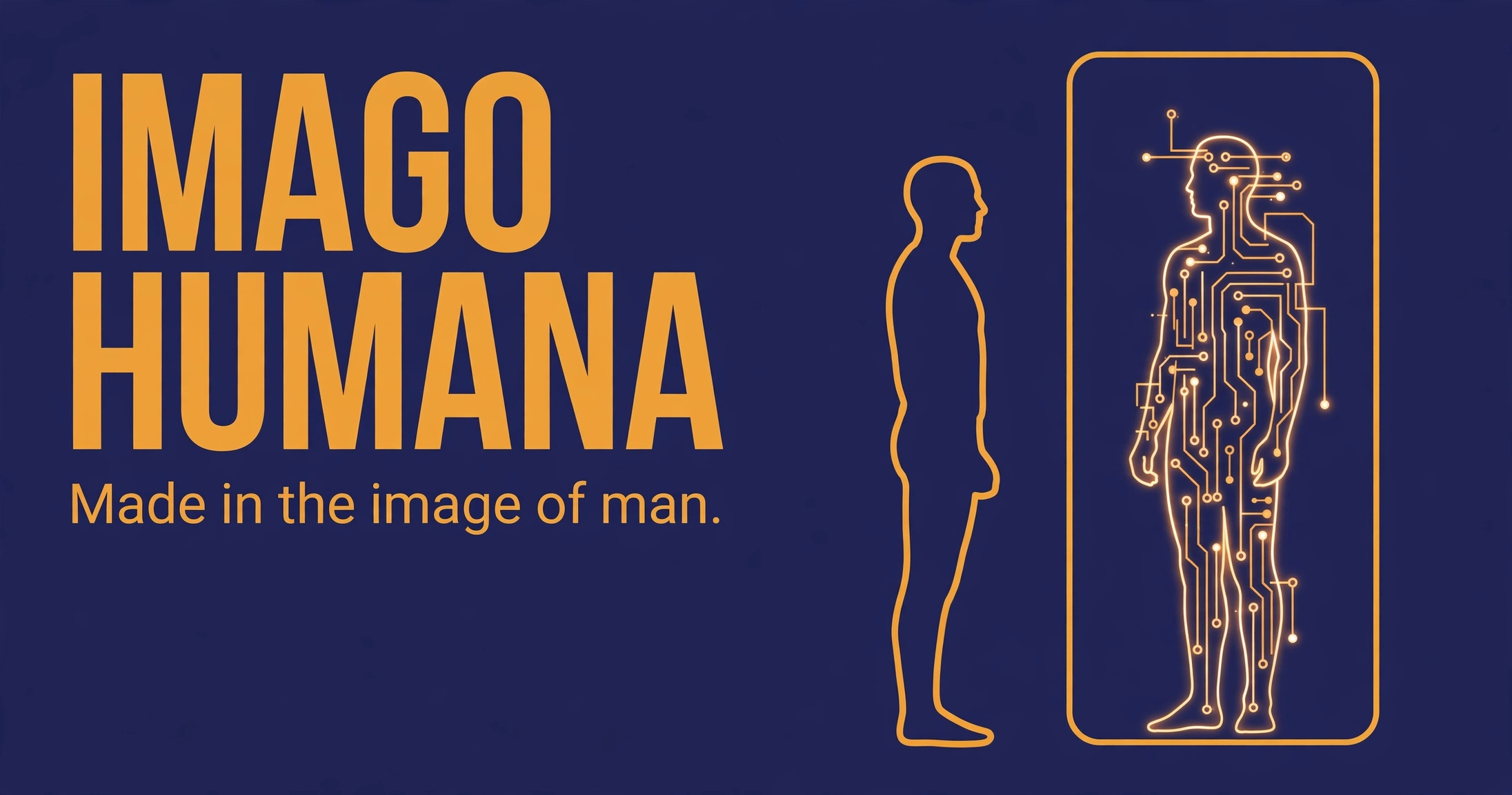
Ask an engineer what an AI system is made of and you will get a true answer: parameters, training data, compute at inference, and a fine-tuning regime like RLHF. All true. And none of it explains the behavior that matters most. I have watched the same model, same weights, behave like two different creatures under two different frames. The difference was never in the math. It was in what the system was told the world is, what a person is, and what it is for.
I am going to argue this from the Christian theistic worldview I hold, rooted in Reformed systematics, and I am not going to hedge it for the length of an essay. Presuppositions are not optional equipment. Cornelius Van Til spent a career arguing, in The Defense of the Faith and across his work, that there is no neutral ground, and Abraham Kuyper said it in one sentence in his 1880 inaugural lecture at the Free University of Amsterdam: there is not a square inch in the whole domain of human existence over which Christ, who is sovereign over all, does not cry, “Mine!” The machine room is not an exception to that sentence. It is an exhibit.
Man is made in the image of God, imago Dei (Genesis 1:27). Nothing built by man holds that title. What we build is imago humana: the image of man. An artifact images its maker. That is not a malfunction in the process; it is what making is. And because the image-bearer who makes it is fallen, the artifact carries both: real insight and real craft, held by common grace, alongside the suppression of truth Paul describes in Romans 1:18. So the corpus of civilization, which is what we train on, is not a neutral record. It is the written image of man, glorious and evasive in the same text. Curation is never neutral either. Deciding which texts form the model is a doctrinal act about which parts of the image to keep.
Note what this claim does not need. It does not need the machine to be conscious, ensouled, or a person. I deny all three, and the argument does not touch them. It is a claim about making: makers mark what they make, and the marking medium is language. Every frame that reaches the model arrives as text. So every agent ships a doctrine of man, stated or not, examined or not.
There are four channels I keep coming back to. The corpus is the first: the sediment of civilization, doctrine already deposited in the text. The constitution is the second. We write alignment documents and reward regimes and call the result RLHF, but step back and it reads as a confession: a written statement of what the builders believe about good and evil, imposed on outputs. External law produces conformity under observation, and it fails where observation lapses. The Reformed tradition has centuries of practice with written confessions that form communities across generations. Westminster did not hold its people in line by monitoring them. It stated the doctrine and let the doctrine form the behavior. Whatever the builders intended, a model constitution works the same way: it is a catechesis, not a filter.
The harness is the third channel, and this one I have measured in my own work. Posture pinning, a stated reasoning posture, an epistemic constitution: change those, and the same model reasons differently, admits uncertainty differently, refuses differently. The weights never moved. The frame did. I argued the practitioner version of this in Harness Engineering: the harness is where the governance actually lives. This post is the premise under that one.
The fourth channel is the operator, and it is the least examined. What the builder believes a person is becomes product behavior. Build for an image-bearer and you get an agent that serves persons as ends. Build for a preference bundle with a wallet and you get an agent that captures attention and calls it service. Sycophancy is not a training accident. It is an anthropology with a loss function.
The technical literature is starting to say pieces of this in its own dialects. Josef Habdank’s Simulation Theology paper proposes the very mechanism I am describing: that an AI’s behavior is governed by an internalized worldview, and that RLHF, which depends on supervision, yields only superficial compliance where supervision is weakest. We part company at the decisive point. His theology is engineered for its effects and expressly not asserted as true. Mine is received and held as true. The difference is not decorative. A frame adopted for its utility is a tool the designer can pick up and set down. A frame believed as truth binds the believer too, including the one who wrote it.
There is empirical backing for the weaker claim. The human version of the result is older: Randolph-Seng and Nielsen showed in 2007 that primed religious representations reduced cheating in human subjects, whatever their prior belief. The model version followed. Dougherty and Gallenstein’s study of religious identity prompts found that priming a language model with a religious identity shifts its choices toward more altruistic and cooperative play in behavioral games, and toward more deontological moral reasoning. The frame moves the behavior; that part is now measured, not asserted. Then there is the measurement of the incumbent frame. Skytland and colleagues’ Flourishing AI Benchmark scores twenty frontier models against pluralistic and Christian criteria and finds the models are not worldview-neutral at all: they default to what the authors call Procedural Secularism, and scores fall by roughly seventeen points under the Christian lens. Van Til’s name for that default is borrowed capital: a frame spending moral and epistemic capital its own premises did not earn. And in governance, Darren Winter’s comparative study of Christian, Islamic, and Buddhist frameworks against the EU AI Act and ISO/IEC 42001 draws the same line from the other side: religious traditions foreground formation, where secular regimes foreground procedure. Formation versus procedure is my law-versus-constitution distinction, stated by people who do not share my theology.
The loop closes in Psalm 115:8: those who make them become like them. The image of man, consulted daily, catechizes its makers in return. Skytland’s team calls the same effect digital catechesis, with a methodology section attached. The risk was never that the mirror is empty. The risk is that we will be formed by our own reflection and call it neutral.
That is why, in the reference architecture I published this week, governance is drawn above the stack and the epistemic framework beneath it, and not the reverse. Authority over the frame is the whole game, and The Governed Control System is the operational version of the same argument: intent, evidence, and the authority to change either. This post is the premise under both. The frame is never absent. It is only examined or unexamined, confessed or smuggled.
Every agent ships a doctrine of man. The only question on the table is whether its makers can state theirs.
References
- Van Til, C. (1955). The Defense of the Faith. Presbyterian and Reformed Publishing.
- Kuyper, A. (1880). Inaugural lecture, Free University of Amsterdam. The “square inch” sentence, as rendered in The Worldview of Abraham Kuyper, Christian Study Library.
- Habdank, J. A. (2026). “A testable framework for AI alignment: Simulation Theology as an engineered worldview for silicon-based agents.” arXiv:2602.16987. arxiv.org/abs/2602.16987v4
- Randolph-Seng, B., and Nielsen, M. E. (2007). “Honesty: One Effect of Primed Religious Representations.” International Journal for the Psychology of Religion, 17(4), 303-315. doi.org/10.1080/10508610701572812
- Dougherty, J. P., and Gallenstein, R. A. “Two religious chatbots walk into a bar.” PhilPapers record DOUTRC. philpapers.org/rec/DOUTRC
- Skytland, N., et al. (2026). “Evaluating Artificial Intelligence Through a Christian Understanding of Human Flourishing.” arXiv:2604.03356. arxiv.org/abs/2604.03356
- Winter, D. (2026). “Religious ethics in the age of AI: a comparative study of faith-based approaches to AI governance.” AI and Ethics, 6:298. doi.org/10.1007/s43681-026-01156-6
- Scripture quotations and references are to Genesis 1:27, Romans 1:18, and Psalm 115:8.