 Thinx-Tank
Harness Engineering: Why the Wrapper Matters More Than the Model
I run an AI agent with arbitrary shell access on my own machines.
That sentence should make you uncomfortable. It makes me uncomfortable, and I built the thing. ThinxAI is my locally-hosted agent framework: system administration, automation, cross-device coordination, running commands with my full user permissions. Its README opens with a HIGH-RISK warning, in capital letters, before it tells you anything else. That warning is not a disclaimer. It is the design brief.
When the agent can do anything, the only thing between intent and disaster is the harness.
What the harness is
The model is the part that reasons. The harness is everything around it: how the agent is bootstrapped, what identity it operates under, what it is allowed to remember, which tools it can reach, what gets logged, what counts as done, and who signs off.
Most of the industry conversation is about the model. Model choice matters less than people think. What matters is the layer that governs it, because the failure modes that hurt you, wrong environment, wrong credential, wrong target, no receipt, are harness failures, not reasoning failures.
Harness importance scales with five things: how long the task runs, how many tools the agent touches, how uncertain the environment is, how bad a mistake would be, and how much assurance you owe someone afterward. Short, supervised, reversible task: the harness barely matters. A long-running agent with shell access doing sysadmin work: the harness is the whole game.
For production or high-assurance work, the harness is the gating layer. A capable model inside a bad harness is not a deployment. It is a demo with credentials.
Build the assurance kernel, not the prompt choreography
Models change every quarter. Anything built out of clever prompting depreciates with each release. What survives is the deterministic shell around the model: the bootstrapping, the gates, the evidence trail, the acceptance step. Put the durable investment there. An assurance kernel around changing models beats prompt choreography that rots every release.
This is what running ThinxAI taught me. The framework I built to govern it is called MxM, and it is deliberately model-neutral. It does not care which model is reasoning today. It defines six surfaces every deployment needs: Mind (how it reasons), Morals (what is obligatory), Mission (identity and scope), Memory (what persists), Methods (how work is done well), and Means (what it executes through).
Three of those surfaces load before any work begins, every session: Mind, Morals, Mission. The other three are pointers, loaded on demand. Context is finite, and the things that constrain the agent must never be the things that get summarized away when context gets tight. The governance core is non-compactable by rule, because summarizing your own constraints is structurally the same as bypassing them.
Authority terminates in a named human
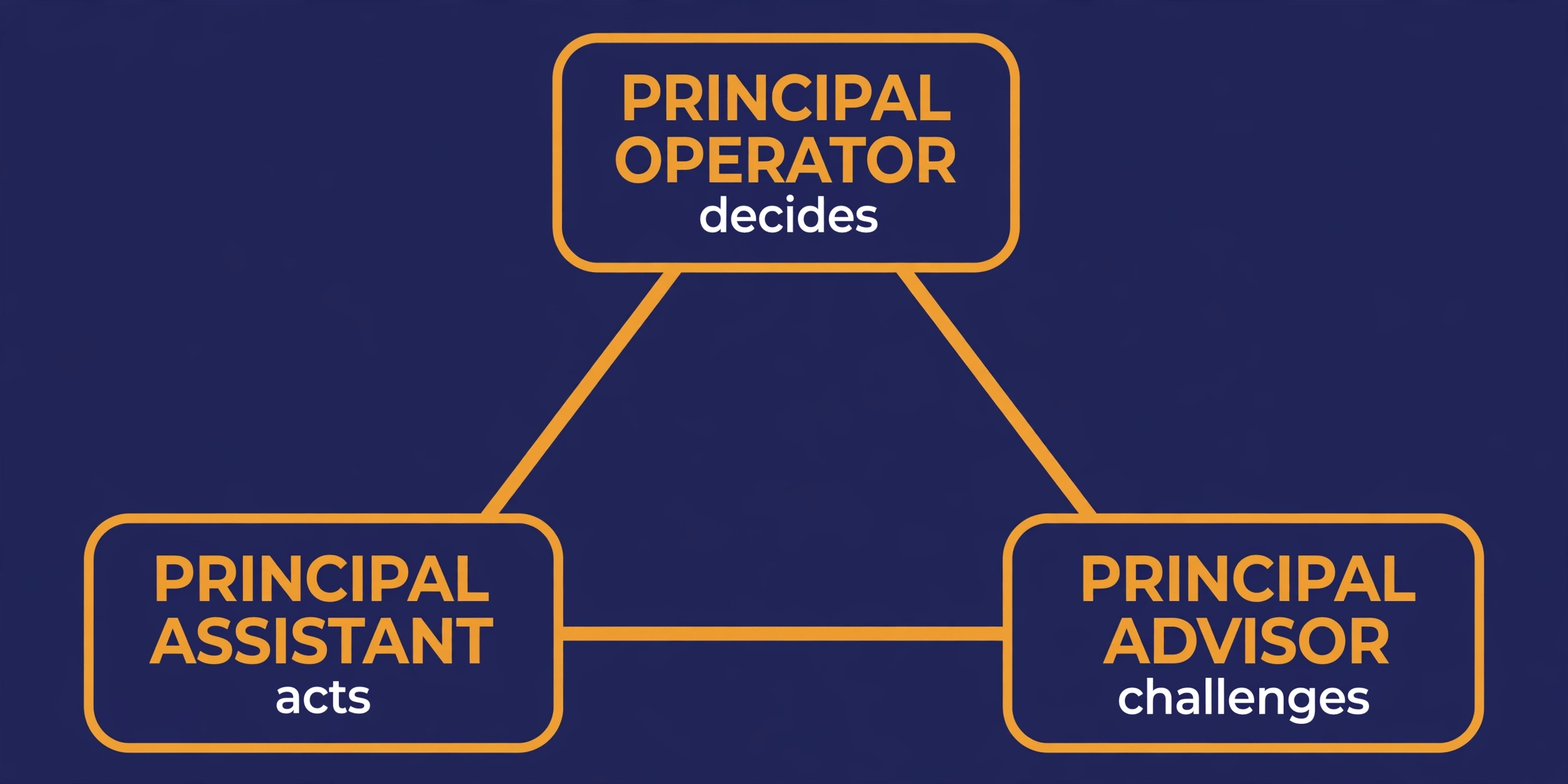
The core governance construct is a triad: the Principal Operator (the human; decides), the Principal Assistant (the aide; acts), and the Principal Advisor (an independent challenge function).
Two design decisions fall out of that, and both are worth stealing.
First, hard-stops are warnings, not absolutes. The harness intercepts a dangerous action and stops, but the operator can authorize one specific command with an explicit override marker and a reason, and the override goes into the audit log. Final authority belongs to the human, not the harness. A control plane the operator cannot override is a control plane the operator will route around.
Second, acceptance is always the operator’s act. The work chain runs from work unit to run to evidence to acceptance, and the rule is written down: observation is not verification, and verification is not acceptance. The agent can show you it did the thing. Only the human decides the thing counts.
Claim your boundaries honestly
Here is the discipline most AI governance writing skips: say exactly what your controls structurally intercept, and admit what they do not.
MxM has three conformance profiles, and they are a ladder, not a badge. Core means the governance surfaces are present and loading. Governed means the work-package lifecycle is actually operating. Enforced means deterministic interception of an enumerated list of hard-stop boundaries. Enforcement is claimed per boundary, never as a blanket statement. The reference implementation documents its own coverage gaps: interception binds specific tool hooks, and raw network clients sit outside it. That is written down up front, not discovered during an incident.
This is how you talk about guardrails without lying. Enumerate what is structurally intercepted, what rests on the reasoning layer’s judgment, and where the human override lives. “Our AI is governed” is a slogan. “Twelve boundaries are intercepted, four rest on policy review, the operator can override any of them with an audit entry” is engineering.
No model bylines
One more rule, and it is absolute: no work product is ever attributed to a model. The single provenance mark is “Human-Curated, AI-Enabled.” No “generated by” lines, no model names in commit trailers. Enforced at the reasoning layer, the harness hooks, and the commit layer.
This is not modesty. It is an anti-automation-bias control. The moment a work product carries a model’s name, the human reviewer starts deferring to it. Attribution shapes accountability. Keep the human’s name on the work and the human keeps doing the reading.
The transferable parts
If you run agents anywhere near production, the pieces worth lifting:
- Separate the reasoning layer from the control layer, and put the durable investment in the control layer. Models depreciate; kernels compound.
- Load governance before work, every session, and protect it from summarization. Constraints that can be compacted away are suggestions.
- Make hard-stops warnings with per-command, audit-logged human override. Authority must terminate in a named human, or people will bypass the harness.
- Claim enforcement per boundary, with disclosed gaps. Blanket “governed” claims are how incidents become surprises.
- Keep humans on the byline. Attribution is an accountability control.
I built ThinxAI because I wanted an agent that could actually administer systems. I built MxM because I did not trust myself to run that agent without it. The model does the thinking. Everything else, the part that keeps it honest, is the harness. That is where the engineering lives.