Thinx-Tank
Critical AI Architecture Strategy Building Blocks
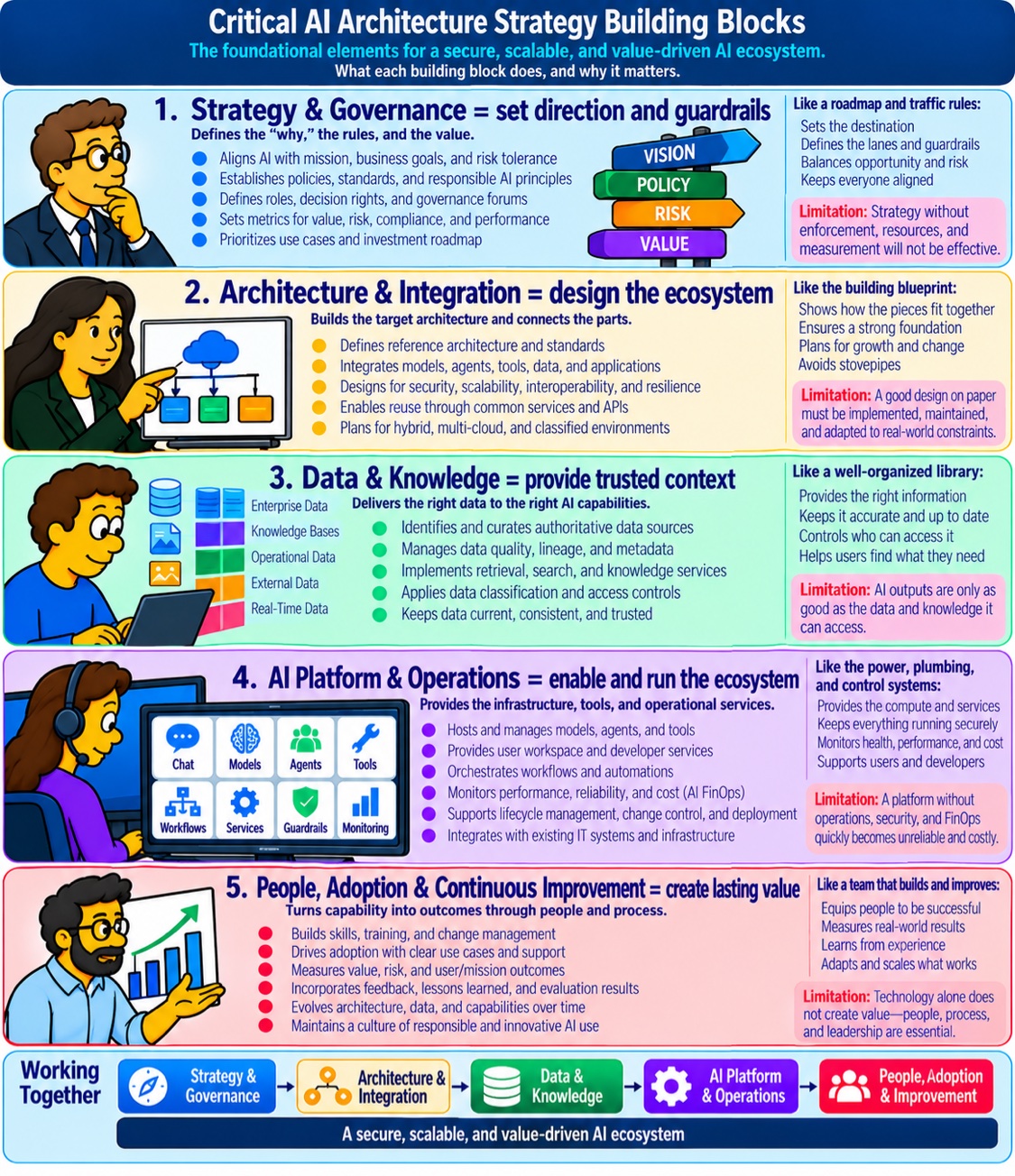
Most enterprises are buying AI tools before they have an AI strategy. That is backwards. Tools are block four of five. Here are the five building blocks in the order they should be laid down, one human analogy each:
1. Strategy and Governance = set direction and guardrails. Like a roadmap and traffic rules. Defines the why, the rules, and the value: aligns AI with mission and business goals, establishes policies and responsible AI principles, defines roles and decision rights, sets metrics for value, risk, and compliance, and prioritizes the use-case roadmap. Limitation: strategy without enforcement, resources, and measurement will not be effective.
2. Architecture and Integration = design the ecosystem. Like the building blueprint. Defines the reference architecture and standards, integrates models, agents, tools, data, and applications, designs for security, scalability, interoperability, and resilience, and enables reuse through common services and APIs. Limitation: a good design on paper must be implemented, maintained, and adapted to real-world constraints.
3. Data and Knowledge = provide trusted context. Like a well-organized library. Identifies and curates authoritative data sources, manages data quality, lineage, and metadata, implements retrieval and knowledge services, and applies classification and access controls. Limitation: AI outputs are only as good as the data and knowledge the system can access.
4. AI Platform and Operations = enable and run the ecosystem. Like the power, plumbing, and control systems. Hosts models, agents, and tools; provides user workspaces and developer services; orchestrates workflows; monitors performance, reliability, and cost (AI FinOps); and integrates with existing IT systems. Limitation: a platform without operations, security, and FinOps quickly becomes unreliable and costly.
5. People, Adoption, and Continuous Improvement = create lasting value. Like a team that builds and improves. Builds skills, training, and change management; drives adoption with clear use cases; measures value, risk, and outcomes; incorporates feedback and lessons learned; and evolves the architecture over time. Limitation: technology alone does not create value. People, process, and leadership are essential.
The order matters. Strategy sets the guardrails, architecture designs the ecosystem, data provides trusted context, the platform runs it, and people turn capability into outcomes. Skip to block four and you get exactly what most enterprises have: expensive tools with no operating model.
This is the strategy layer. The AI Operations Center is the operating model that runs it day to day.