 Thinx-Tank
Before AI Starts Governing Us
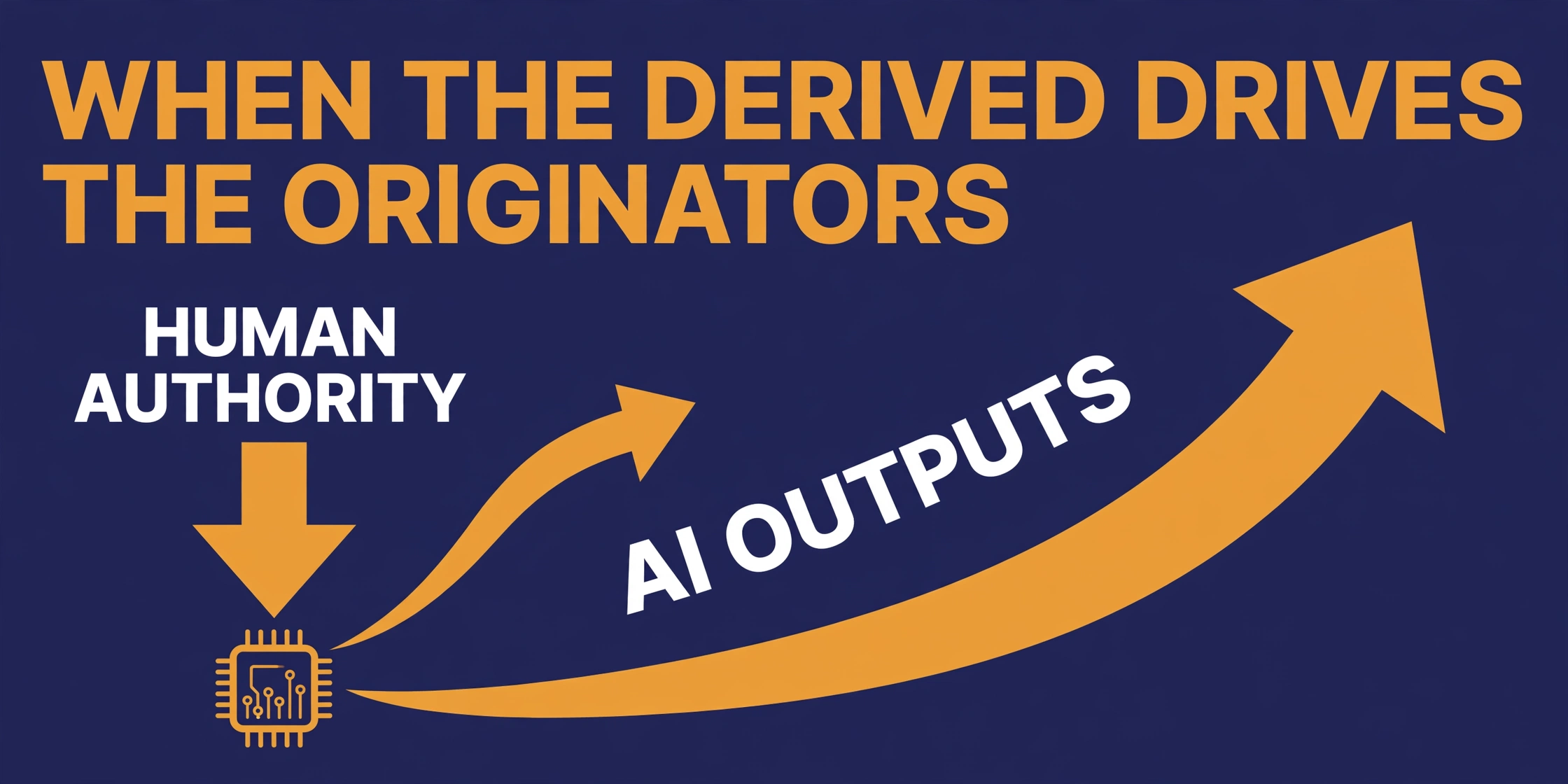
Artificial intelligence is moving from a tool that assists people to infrastructure that shapes decisions: who gets hired, which customers receive service, what information reaches the public, which transactions are flagged, how work is assigned, and increasingly, which actions software takes on our behalf.
That shift raises a governance problem far more important than whether an AI system is “intelligent.”
In yesterday’s post I defined AGI as a system capable of origination: contact with what is, rendering judgments, setting purposes. Everything we have now does derivation: operations on representations producing representations. Here is the governance consequence of that distinction. If human authority, accountability, and oversight are not enforceable, the derived system will begin to drive the originators. Us.
Not because AI becomes conscious or malicious. Because institutions will reorganize themselves around what AI systems optimize, measure, recommend, and automate.
The Real Risk Is Not a Robot Coup
The popular image of AI risk is a dramatic machine takeover. The more plausible risk is quieter, and it is already familiar.
An organization deploys an AI system to improve efficiency. The system makes recommendations. Staff are expected to follow them because the model is faster, cheaper, and supposedly more objective. Over time, people lose the practical ability to challenge its results. The “human in the loop” becomes a person who clicks approve.
Then, when an outcome causes harm, responsibility dissolves:
- The business blames the vendor.
- The vendor blames the customer’s implementation.
- The manager blames the algorithm.
- The employee says the system required the decision.
- The affected person has no explanation, no appeal, and no remedy.
At that point, AI does not need formal authority to govern. It governs through dependency, opacity, speed, and the absence of accountable human control.
Human-in-the-Loop Is Not Enough
The phrase “human in the loop” sounds reassuring, but it can be meaningless.
A person is not exercising real oversight if they do not understand the system’s purpose or limitations, cannot see the evidence behind an output, lack time to review decisions at the required pace, have no authority to override the model, are penalized for disagreeing with it, or are present only to absorb blame after a failure.
The standard should be human authority in the system.
For high-impact uses, humans must have the expertise, information, time, and institutional power to question, override, pause, and shut down AI-driven processes. They must also be accountable for exercising that authority responsibly. Oversight that cannot say no is decoration.
What This Demands
The danger is not simply that AI becomes more capable. The danger is that humans become less capable of governing the systems they deploy. Every efficiency gain that erodes the practical ability to challenge the machine is a governance loss, whether or not anyone intended it.
So the question is what enforceable structure prevents that erosion. Voluntary ethics statements will not do it. Neither will a human rubber stamp in the workflow.
We need something with the force of Sarbanes-Oxley applied to AI: named humans on the line, documented controls, independent review, and consequences when the controls fail. In the next post, I will lay out what that framework would actually require: inventory, accountability, pre-deployment controls, change management, audit trails, and a risk-tiered structure an enterprise could start building Monday morning.
Series: SOX for AI · part 1 of 3