Thinx-Tank
AI Operations Center, a Human Analogy
There is a noticeable lack of enterprise strategy and architecture for AI Operations. Everyone is deploying agents; almost nobody has built the operating model to run them. The AI Operations Center is my answer: a governed environment for people and AI to access, operate, and manage the AI ecosystem. Centralized tooling, with people retaining defined authority, accountability, and control.
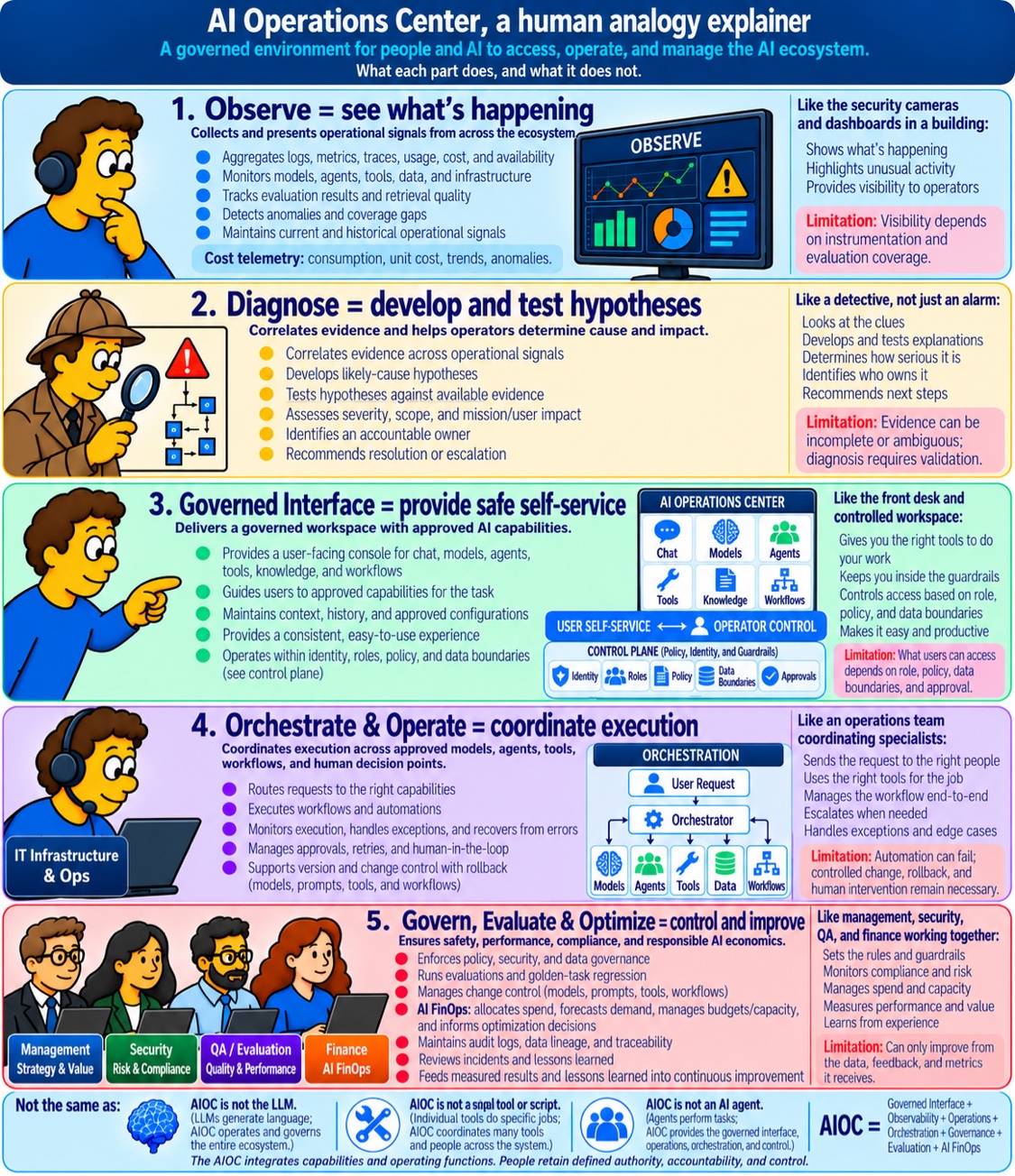
This is the human-readable companion to the Agentic Execution Control Plane architecture. Five functions, one human analogy each:
1. Observe = see what’s happening. Like the security cameras and dashboards in a building. Aggregates logs, metrics, traces, usage, cost, and availability from across the ecosystem; tracks evaluation results and retrieval quality; detects anomalies and coverage gaps. Includes cost telemetry: consumption, unit cost, trends, anomalies. Limitation: visibility depends on instrumentation and evaluation coverage.
2. Diagnose = develop and test hypotheses. Like a detective, not just an alarm. Correlates evidence across operational signals, develops likely-cause hypotheses, tests them against available evidence, assesses severity, scope, and mission impact, and identifies an accountable owner. Limitation: evidence can be incomplete or ambiguous; diagnosis requires validation.
3. Governed Interface = safe self-service. Like the front desk of a controlled workspace. A user-facing console for chat, models, agents, tools, knowledge, and workflows, guiding users to approved capabilities within identity, roles, policy, and data boundaries. Limitation: what users can access depends on role, policy, data boundaries, and approval.
4. Orchestrate and Operate = coordinate execution. Like an operations team coordinating specialists. Routes requests to the right capabilities, executes workflows and automations, monitors execution, handles exceptions, manages approvals and human-in-the-loop, and supports versioning and rollback. Limitation: automation can fail; controlled change, rollback, and human intervention remain necessary.
5. Govern, Evaluate, and Optimize = control and improve. Like management, security, QA, and finance working together. Enforces policy, security, and data governance; runs evaluations and golden-task regression; manages change control; does AI FinOps (allocates spend, forecasts demand, manages budgets); maintains audit logs, data lineage, and traceability. Limitation: it can only improve from the data, feedback, and metrics it receives.
And what the AIOC is not:
- Not the LLM. LLMs generate language; the AIOC operates and governs the entire ecosystem.
- Not a snap tool or script. Individual tools do specific jobs; the AIOC coordinates many tools and people across the system.
- Not an AI agent. Agents perform tasks; the AIOC provides the governed interface, operations, orchestration, and control.
AIOC = Governed Interface + Observability + Operations + Orchestration + Governance + Evaluation + AI FinOps.
The AIOC integrates capabilities and operating functions. People retain defined authority, accountability, and control.